What is a Sensor?
A Sensor can be defined as a device capable to make certain features, like read signals, which is normally controlled by analog gates but it is also possible in digital gates. Nowadays there are important sectors that begin to depend on sensors for various applications, like for example medicine, robotic and general industries.
Most sensors work in response to an external stimulus, that is, the energy that it receives is transform to an electric signal, this kind of sensors are called Transducers.
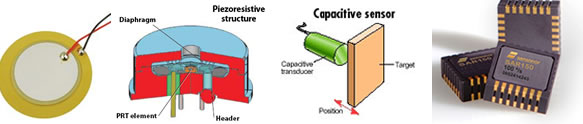
The transducers are composed of elements, usually Piezoelectric, whose function is to convert the energy received in electric signals.
Characteristics!
The characterization of a sensor is made according to the type of energy they detect, as there are many types, which the most common are:
- Light Sensor – photo-diode; photo-transistors…
- Sound Sensor – microphones; hydrophone…
- Temperature Sensor – thermometers, thermo-couples…
What is a Vibration?
It is said that vibration has an oscillating movement around a reference point, fixed point. The variation of motion is measured is millimeters or inches, the number of times the movement runs as a cycle is given in Hertz (Hz), which is called Frequency.
Normally, to measure the vibration of machines and engines the following units are used:
Acceleration: meter per second squared (m/s2);
Speed: meters per second (m/s) or inches per second (ips);
Offset: micrometer (1 micron equals 0.001 mm)or mils (1 mil equals 0.001″).
The equipment that is used to measure vibrations is called the vibrometer, which is composed by a transducer system, which converts mechanical vibrations into energy, better known as: accelerometer.
Which vibration sensors are most commonly used?
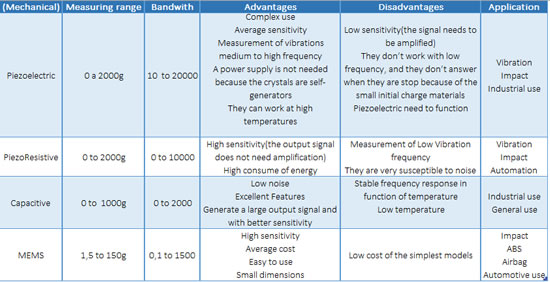
The sensors most commonly used to measure vibration are the piezoelectrics and the piezoresistives.
But the most elaborate are the Accelerometers.
What is an Accelerometer?
The accelerometer is a device that is used to measure the acceleration itself, change of slope, velocity, displacement, force and vibration.
The acceleration itself differs from the acceleration (in the conventional sense of speed change rate) because it is linked to heaviness as a given reference. An accelerometer is unable to measure the acceleration of an object in free fall, for example. The heavy feeling in an accelerometer in free fall in the sun or moon is zero although the acceleration is quite different in these cases.
Accelerometers are devices that can operate from different physicals effects and therefore they have a wide range of acceleration values which they are able to measure, just has a very high range of applications. These devices are mainly used in positioning systems, tilt sensors and vibration sensors.
Starting form Newton´s second law, it’s possible to build several types of accelerometers.
Imagine a cup with ½ of water. If we put the glass in the top of a flat surface and after if we push it forward we will notice that the water will move relatively to the cup.
Nowadays Accelerometers have been highly used to monitor the conditions of machines to predict failures.
There are two different types of accelerometers, the mechanical ones and the microelectromechanical ones.
Types of accelerometers
Which one is the best for vibration measurement?
Within the accelerometers those who are more used to calculate the vibrations are the piezoelectric accelerometer, the piezoresistive accelerometer and the MEMS.